The Continuous SDLC Compiler Loop
A structural model for continuous SDLC governance — applying compiler-style reasoning across the lifecycle.
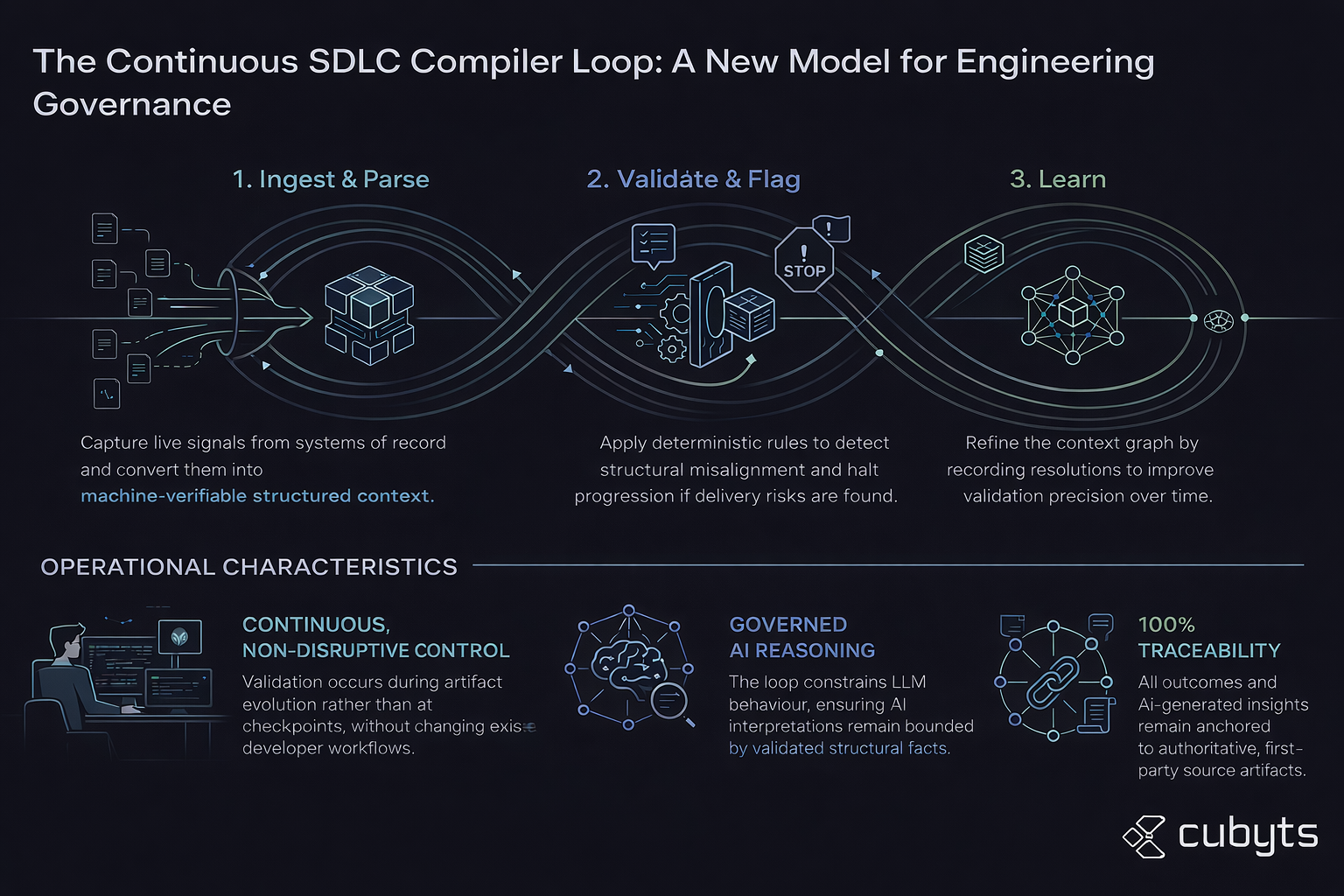
The Continuous SDLC Compiler Loop describes how intelligence is applied across planning, development, release, and post-delivery activities as a continuous control mechanism.
Five Deterministic Stages
1. Ingest — Capture authoritative SDLC signals from systems of record: requirements, design, source control, releases.
2. Parse — Convert raw artifacts into structured context: typed artifacts, explicit relationships, temporal states.
3. Validate — Apply deterministic rules across dependency integrity, ownership boundaries, and known drift patterns. Validation precedes all generative reasoning.
4. Flag — Surface structural misalignment anchored to concrete artifacts and relationships.
5. Learn — Refine context without altering source artifacts. Improve precision over time.
Operational Characteristics
- Validation occurs continuously, not at predefined checkpoints
- Structural issues are detected during artifact evolution, not after release
- All outcomes remain traceable to source artifacts
- The loop operates alongside existing SDLC tools without workflow changes
Within this model, AI is not an autonomous decision-maker. It operates as a governed reasoning component inside a deterministic system.