
Turning Delivery Signals into Business Confidence
A CBO's view: predictable delivery creates commercial confidence. SDLC signals turn customer commitments into outcomes you can defend with evidence, not optimism.
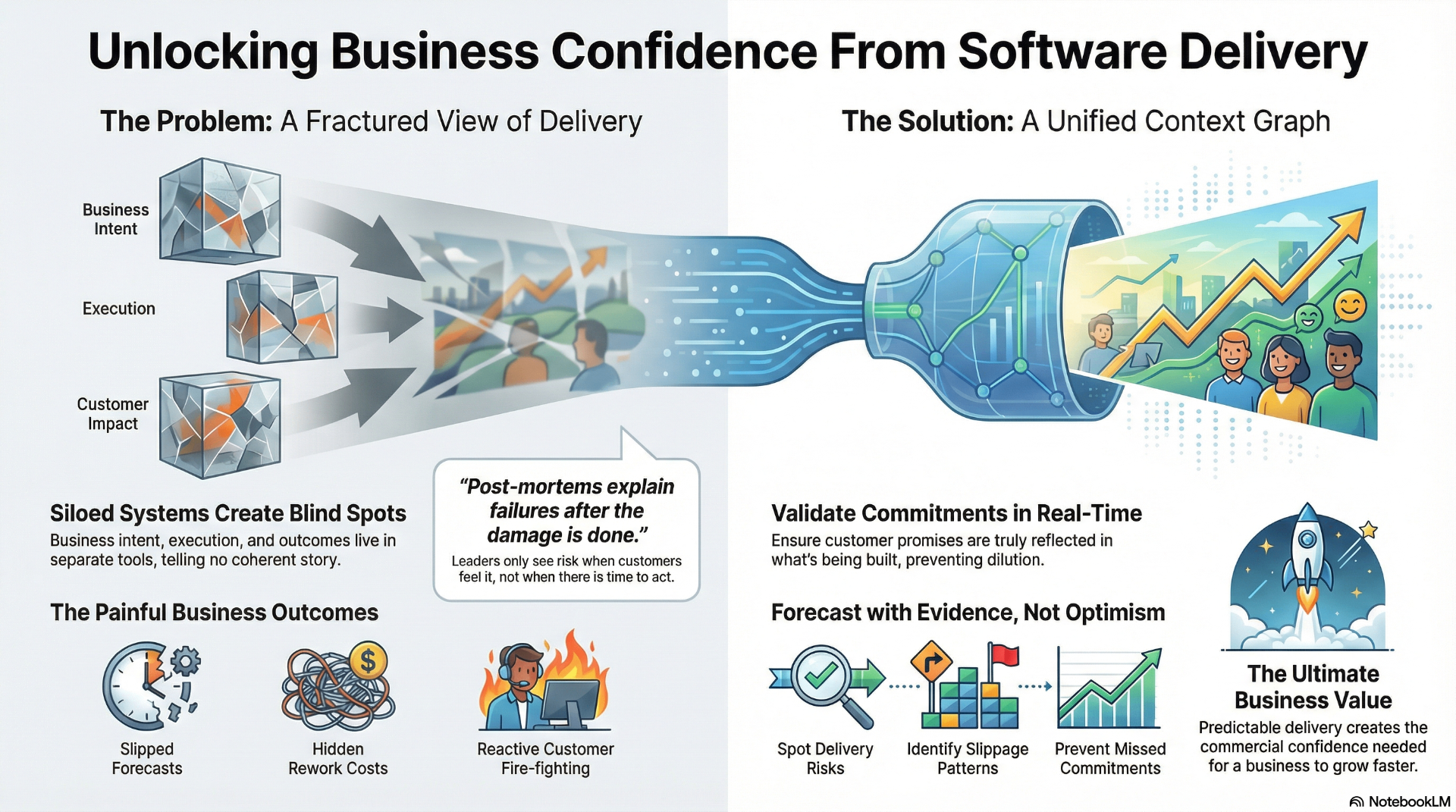
As a Chief Business Officer, I spend less time worrying about how software is built and more time worrying about what it does to the business.
- Are we delivering what we committed to customers?
- Can we forecast releases with confidence?
- Do we see risk early enough to act — or only when customers feel it?
In most organizations, these questions are surprisingly hard to answer with certainty.
The Business Reality Behind Software Delivery
Roadmaps sit in decks. Commitments live in contracts. Work is tracked in tickets. Code lives in repositories. Quality shows up in test results. Customer impact appears through support and renewals. Each system works. Together, they do not tell a coherent story.
What a Delivery Signal Means in Business Terms
When all delivery signals are pulled into a single, traceable view of reality — an SDLC Context Graph — leaders can finally see what was promised, how it was interpreted, where execution drifted, when risk started accumulating, and how issues reached customers.
What Business Leaders Actually Get
- Earlier warnings on slipping forecasts and recurring rework
- Evidence-backed conversations with customers, not blame-driven narratives
- Capacity allocated toward progress, not correction
As AI accelerates software creation, volume is no longer the bottleneck. Confidence is. Predictable delivery is what allows businesses to grow faster.