A Unified Code Intelligence Approach for Continuous Alignment Across the SDLC
As software systems grow, teams struggle to keep intent and execution aligned. A unified intelligence layer validates alignment continuously across the lifecycle.
As software systems grow in scale, engineering teams struggle to maintain alignment between intent and execution. The challenge is not capability or effort — it is the absence of a unified intelligence layer that continuously validates alignment across the SDLC.
The Alignment Challenge
Every transition — requirements to stories, stories to code, code to tests, releases to incidents — introduces interpretation risk. Over time this leads to late discovery of contradictions, quality degradation, bloated test suites, and slow root-cause analysis.
A Unified Model
A more resilient model treats the SDLC as a connected system rather than a sequence of handoffs, relying on: - Semantic understanding of code and system structure - Traceability across requirements, work items, code, tests, and incidents - Guardrails derived from approved decisions and standards - Continuous validation instead of stage-gate inspection
Intervention Points Across the Lifecycle
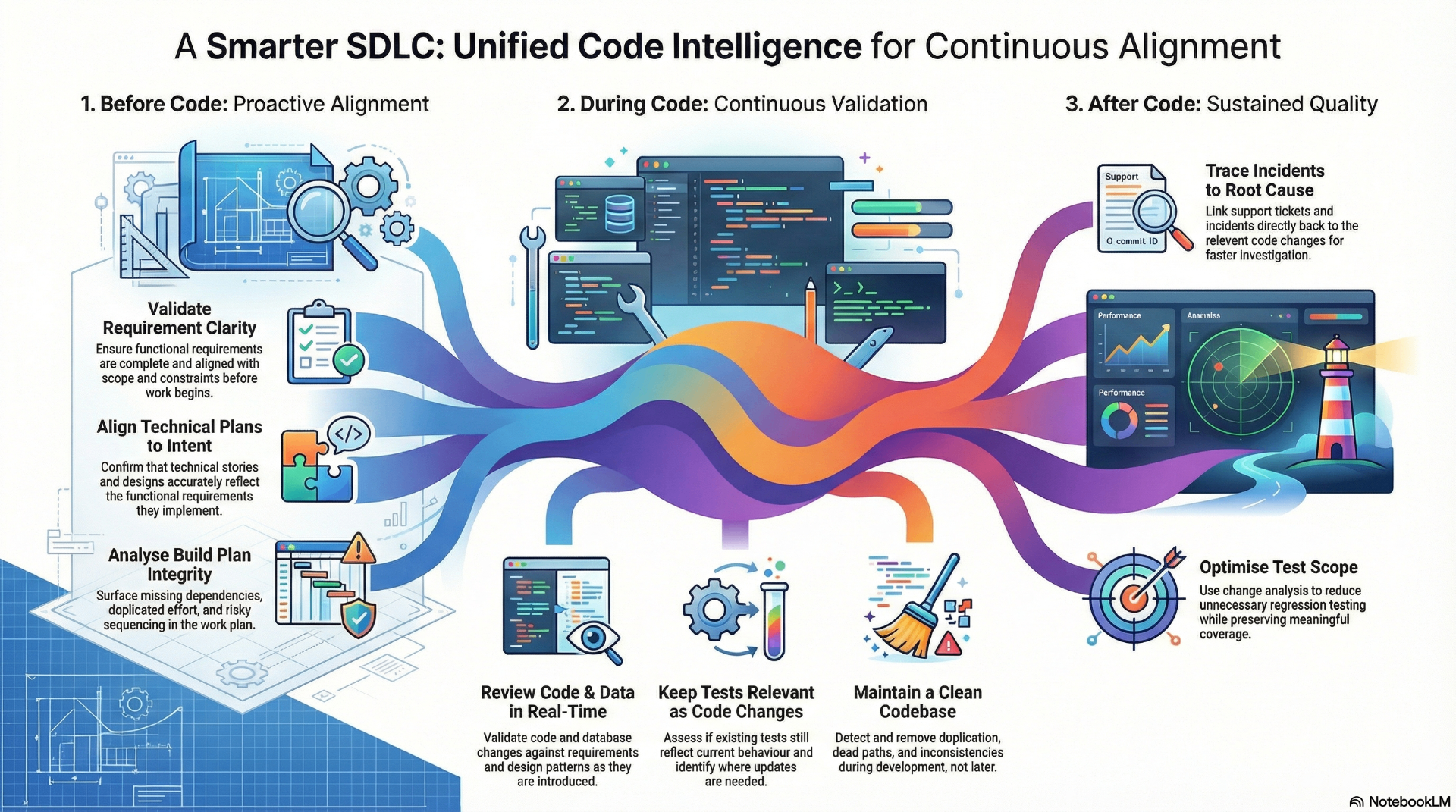
Before code: requirement completeness, mapping technical stories to functional intent, detecting conflicting decisions, test intent validation, and build plan integrity.
During code: continuous code and data-layer review, test relevance during code evolution, and continuous codebase cleansing.
After code: dual-layer documentation (technical and functional), root-cause traceability, and test scope optimization.
Why It Matters
A unified intelligence layer enables zero rework by catching contradictions early, consistently high-quality delivery through continuous validation, and a shared semantic view across teams — without disrupting existing tools or workflows.